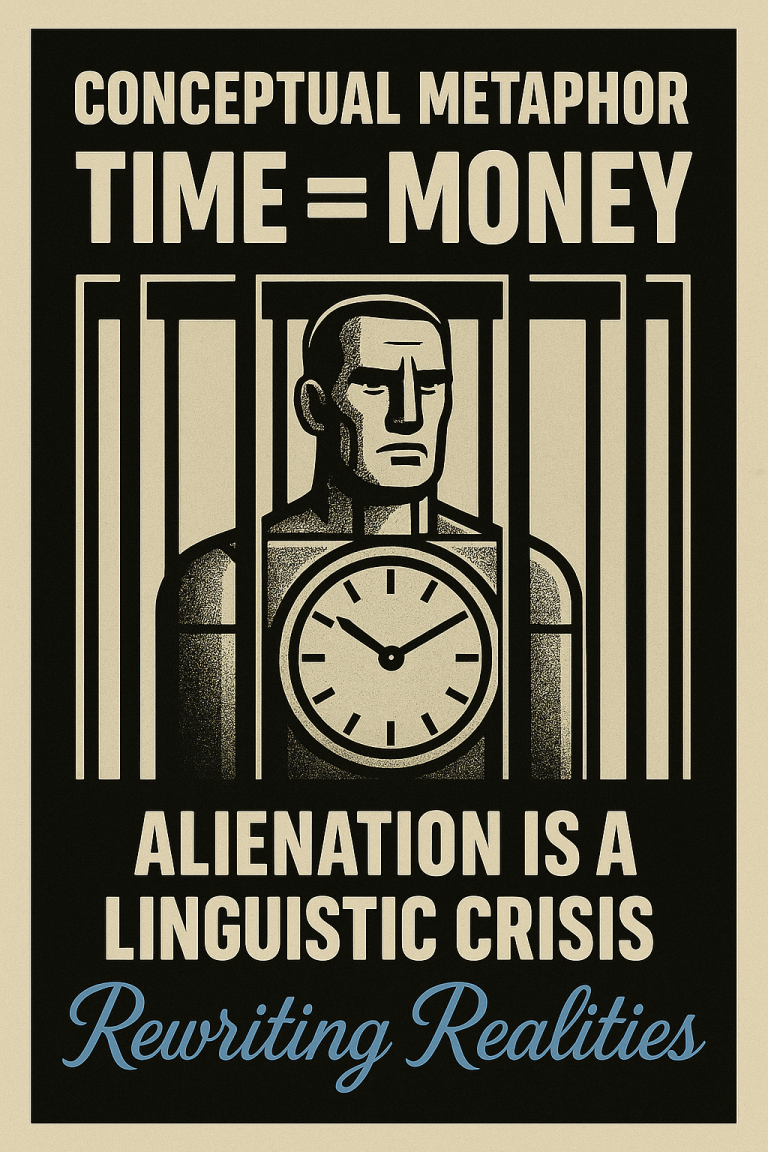
Alienation is a Linguistic Crisis
TIME = MONEY: How a Metaphor Became Our Cage
by Rewriting Realities
This is the first of three essays in the Rewriting Realities installation, exploring how language, culture, and economy can be rewritten.
"Time is money"
Most of us have heard that phrase so often we no longer question it.
But what if it’s not just a phrase,
but the opening line of a story we never agreed to live?
A story that taught us to see time not as life unfolding,
but as a resource to spend, save, or lose.
Language as Code and Story
Language is not neutral.
Words are not labels for a pre-existing world.
They are the architecture of how we experience reality.
According to cognitive linguists like George Lakoff and Mark Johnson,
we live within conceptual metaphors:
invisible bridges between ideas that shape our behavior
and define what seems “natural.”
TIME=MONEY is one of the most powerful metaphors of our era.
It is also the plotline of a story we didn’t write.
It teaches us that time is a possession to optimize,
that “wasting” time means losing value,
that a good life is measured by productivity.
But this is not a universal truth.
It is a cultural algorithm.
It became dominant during a specific historical moment:
the rise of industrial capitalism.
Derrida’s Insight: Language as Difference
French philosopher Jacques Derrida showed that language is not a clear mirror of reality.
Meaning is always in motion.
There is no final, fixed reference - only a chain of signs,
shaped by absence, delay, and what he called différance:
meaning always deferred, always relational.
In this view, no story is ever just true.
There are only stories, told and retold until they appear inevitable.
TIME=MONEY is one of those stories.
It feels timeless.
But it is historically coded.
Metaphysics as Cultural Software
In the nineteenth century, as industrialization reshaped the world, time was redefined.
From something cyclical, sacred, and shared,
it became something linear, measured, and monetized.
Enlightenment thinkers had already imagined time as a line,
a forward path, a promise of reason and progress.
But it was the factory bell that made it law.
Time became debt.
The clock became a whip.
This shift embedded itself in our institutions:
schools, governments, economies.
And ultimately, in our bodies.
We learned to sit still when we longed to move.
To obey bells and deadlines instead of our rhythms.
To measure worth in hours, outcomes, and exhaustion.
These metaphysical shifts did not only change our routines.
They changed our perception of what reality is.
The Observer Shapes the Real
Modern physics has abandoned the myth of a detached, objective world.
In quantum theory, observation affects what is observed;
the observer is not separate from the field but intertwined with it.
The observer shapes the field in the very act of seeing.
So too with language.
Each word we speak does not merely describe reality;
it participates in its unfolding.
Words are not only descriptions, they are actions:
promises, laws, songs, and stories that can wound or heal,
divide or unite.
We are not passive recipients of meaning.
We are co-authors of worlds.
This is not to obscure the real,
but to reveal how reality is made.
Alienation: A Story That Hurts
Alienation is not just a feeling.
It is a cultural condition.
It arises when the story no longer fits reality.
When the words we have been given
no longer align with existence itself.
We carry an archaeology of meaning,
and some of its concepts are wounding the living world.
Many of us feel it:
the constant pressure to perform,
the anxiety of “wasted” time,
the disconnect from nature, from others, from ourselves.
But what if alienation is not a personal failure?
What if it is a linguistic wound,
a crisis of language itself,
inflicted by a story too small for the truth of who we are?
And what if this wound does not stop at the individual?
What if the same story that alienates us from ourselves
also estranges us from the Earth?
We Are Running Out of Time
The metaphor TIME=MONEY doesn’t just shape our lives.
It shapes how we treat the Earth.
Forests become resources.
Rivers become assets.
Species become losses on a balance sheet.
We are taught to extract, optimize, consume;
not to listen, not to relate.
And now, we are running out of time.
Geologically, ecologically, irrevocably.
The Amazon rainforest, often called the lungs of the Earth,
is approaching a tipping point.
If deforestation continues,
the forest will no longer sustain its own rainfall cycle.
What dies is not just the forest.
It is the story of continuity itself.
And when the forest falls,
it will not only be Brazil that suffers.
It will be all of us.
Yet stories can change before the point of no return if we dare to rewrite them.
Time for a New Story
What if we could change the plot?
What if we chose to tell a different story, one where:
• Time is life, not currency
• Value comes from being, not producing
• Work is not labor, but expression of human potential
This is not utopia.
It is a shift in code.
Because language is never fixed.
Stories can be rewritten.
And with them, realities can shift.
Derrida called it a new grammar.
We might call it
a living story of presence.
The poster belonging to this essay is a reminder that this equation is not law - but a story we can choose to change.
Toward a New Grammar of Existence
What we call the future
is already being shaped by the words we choose today.
Reality isn’t something fixed or outside of us.
It unfolds as we speak.
We do not enter time.
We are time, dreaming itself forward.
There is no future.
Only the rhythm of now,
forever rewriting itself
through us.
This essay is only the first seed. Alongside the essays Value by Being and UBI is Social Healing, this poster installation is an invitation to rewrite the human story together. This essay is part of the Rewriting Realities exhibition at the BIEN Congress in Brazil.
✹ Critical Thinking Questions – Language, Metaphor & Awareness
For readers, students, and co-creators of a new story:
- What dominant metaphors or sayings shape how you think about time, work, and worth?
- Can you recall a moment when the story you lived by no longer felt true?
- How does the metaphor “Time = Money” influence how you value yourself or others?
- Where in your life do you feel pressure to perform rather than simply live?
- How might changing the metaphors we use (for time, work, value) shift how we relate to each other and the Earth?
☀️ Invitation
We invite you to go deeper.
Take the ideas from these essays as a starting point, not an endpoint.
Use them to question your own assumptions, research your own thinking, and imagine the world you most want to live in.
What would a society look like where everyone truly belongs?
How could unconditional basic income support that vision?
Write your best envisioned possible reality.
Reflect, dream, and send me your essay.
You are welcome to collaborate with ChatGPT or any other tools that help you clarify your thoughts.
What matters is your authentic vision.
Send your reflection or essay to:
📩 rewritingrealities@outlook.com
Your voice matters.
The world is not something we wait for.
It is something we rewrite.
Together.
Because you are.
Value by Being.
A world where everyone can live begins now.
Will you join us?