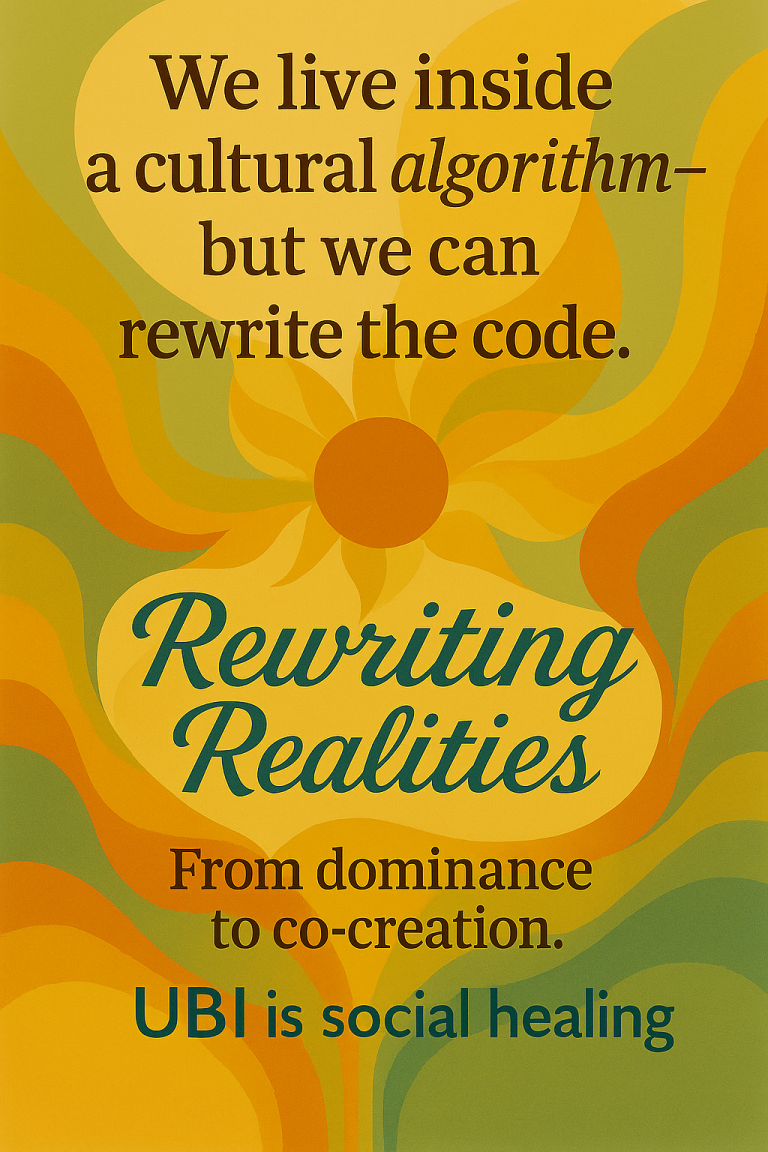
Rewriting the Code:
UBI is Social Healing
by Rewriting Realities
This is the third of three essays in the Rewriting Realities installation, exploring how language, culture, and economy can be rewritten.
An Old Story
We are born into a story older than memory.
A story carved in conquest, mined in extraction.
They called it progress.
They called it civilization.
But what they built was Empire -
breaking our bond with Earth, with the mother, with each other.
A system where disconnection is rewarded,
care is treated as weakness,
and life itself is made conditional.
Stories are never neutral.
They decide who matters and who can be erased,
whose lives are protected and whose are dehumanised.
And we don’t just hear these stories, we internalize them.
They sink into our language and laws.
They shape how we think,
how we see ourselves,
how we perceive the world.
Long before we can question them,
we are trained to live by their rules.
Grammar of Survival
None of us consented to this story.
Yet we were born inside its grammar.
It shaped the lullabies our grandmothers sang,
the laws that govern our bodies,
the myths that tell us what is possible.
We were programmed by its rules before we had words.
They run in the background like code,
quietly teaching us what to fear and what to chase.
We learned to silence our needs,
to apologise for existing,
to mistake survival for living.
Over time, we confused this programming with who we are.
But identity built on fear is not our essence.
It is a costume stitched by culture,
a survival mask mistaken for a self.
Our deeper nature has never been lack or competition.
It has always been connection.
Life’s True Law
We were told that survival is the law of life.
But life’s true law is the law of nature, the law of existence -
not competition, but co-creation.
Not conditional worth, but unconditional belonging.
Lichens prove it: life grows through symbiosis, not domination.
Every thriving ecosystem shows the same truth:
what lives, lives through relationship.
Alienation begins when the law of culture breaks away from the law of existence,
when trauma rewrites the principles of life.
But beneath all that, the heart of life itself has never stopped pulsing:
a quiet resonance that holds us even when we fall into dissonance,
gently calling us back into harmony with the mother who sustains us.
Trauma Across Time
And yet Empire rewrote life’s law.
It replaced partnership with fear and control.
It extracted instead of nurtured.
It built wealth by erasing cultures, severing kinship,
uprooting people from land and from each other.
Domination cultures did not just suppress partnership cultures;
they often destroyed them.
Genocides and ethnocides scar our shared history,
and the pattern has not ended.
Even today, entire peoples are made targets,
their lives and their ways of being erased,
from the Amazon to Gaza and beyond.
The violence continues wherever difference is unwanted,
where roots are severed and memory is erased,
as if humanity were meant to forget its roots
and be reforged according to an old techno-utopian dream.
The wounds of conquest and control did not stay in the past.
They echo through generations.
Trauma travels in families, in cultures, in bodies.
What was done to our ancestors lives on in our nervous systems.
The lash may be gone, the chains removed,
but the body still flinches, the heart still aches.
As Gabor Maté teaches in The Wisdom of Trauma:
trauma is not the event itself,
but the inner split when it is not safe to feel.
And trauma is not only personal; it is ancestral.
It is written across time.
A System Built on Fear
Look around and its patterns are everywhere.
Families repeating what they swore they would never do.
Societies praising endurance while ignoring what it costs.
Policies that punish tenderness.
Economies built on extraction and erasure.
Institutions that enforce sameness, demand obedience,
reward performance, and pathologize pain.
Support exists, but only if you play the part,
accept the diagnosis, let your wound be named a disorder.
Healing is rarely the goal.
Healing is bad for business.
Difference is treated as a threat;
a healthy, diverse population is harder to control.
A regulated nervous system cannot be coerced.
Those who refuse compliance are pushed into poverty,
and those who suffer are held responsible for the system’s crimes.
The Drama Triangle Made Systemic
We live inside a drama triangle scaled up to a system, a psychological model that describes recurring roles of victim, rescuer and persecutor in unhealthy relationships.
It has been institutionalized.
It tells us someone must dominate and someone must submit.
It disguises coercion as care and calls it order.
It blames the suffering for their suffering,
while rewarding the powerful for their harm.
Under patriarchy, what gives life was made suspect.
Feminine power - its knowing, its cycles, its creative force,
its ancient sense of connection with the cosmos - was feared and suppressed.
These are not “women’s traits,” but metaphysical qualities of life itself:
the yin to the yang, the balancing principle we all carry.
Empire wounds what it depends on:
it violates Earth, injures mothers, shames softness, silences difference,
and demands that even children adapt to its pace.
It teaches us to distrust what cannot be measured,
to fear what cannot be owned:
empathy, vulnerability, interdependence.
Rewriting the Code
Culture is not a force of nature;
it is a program, an algorithm.
The code of Empire was written by human minds,
in thoughts and actions, enforced through habits and institutions.
What we call “support” inside such a system is rarely true care;
it is scripted survival.
Pain managed as performance.
Pain used as a tool of coercion.
But here is the opening: the system is not an abstract machine.
It is made of us: our choices, our silence, our courage.
As the first essay showed, Empire used words to shape law and society.
We can use words to rewrite the terms of life.
If it was written by people, it can be rewritten by people.
We live inside a cultural algorithm.
Its code is made of metaphors:
Time is money. Worth is earned. Care is a cost.
When language shifts, realities can shift.
Stories are not ornaments; they are operating systems.
Everything we call “the economy” or “society” lives inside a story,
and because it is a story, it can be told differently.
It can be rewritten.
UBI as Nervous System
Unconditional Basic Income is one way we begin to rewrite the code.
It is not charity.
It is social infrastructure, the nervous system of a society that no longer rewards exhaustion.
Imagine a society built on trust rather than suspicion.
Where the right to live is automatic,
not something you must constantly prove with paperwork and performance.
Technology can serve this vision:
AI and collective systems handling the bookkeeping of rights in the background,
quietly and reliably, like a healthy nervous system.
No more endless forms to prove your existence.
No more humiliating tests of worthiness.
No more gatekeepers deciding who gets to eat or rest.
Imagine never having to beg for help again,
knowing your safety is as unquestioned as the sunrise.
UBI interrupts the cycle of coerced survival.
It makes space for healing that reaches across time.
It offers what trauma has always needed: safety without condition.
It is not just survival; it is permission to thrive.
It makes space for care, for creation, for rest,
for gifts no market can measure.
For life to be lived, not performed.
Human Potential Unlocked
And this matters, because human potential is not a prize for the few.
It is the birthright of all.
But potential needs ground to grow.
We do not blossom when terrified.
We do not innovate when chronically unsafe.
We grow when our needs are met and dignity is assured.
We grow when difference is welcomed,
when belonging is not up for negotiation.
UBI does not ask you to prove your worth to earn your right to exist.
It simply affirms it:
You are.
Unconditional.
Value by Being.
Because when survival is no longer weaponized against us,
we can finally turn our energy to what makes us fully human:
care, creation, learning, love.
Every person is born carrying a spark of genius,
but a system built on fear and control smothers it.
With safety as our ground, that brilliance can unfold,
not just in knowledge and inventions,
but in empathy, wisdom, and collective insight.
A society that nurtures its innate genius
is a society with more art, more science, more compassion,
and the courage to face our shared challenges together.
Toward a New Story of Existence
When every person’s needs are met and their genius allowed to grow,
we are not just changing an economic rule.
We are rewriting the story of what it means to be human.
This is more than policy.
It is cultural repair:
the collective nervous system learning to relax, to trust, to breathe.
A shift from dominance to co-creation, from fear to belonging.
A society remembering that life is not an Olympic tournament;
it is a living web.
We are not passive recipients of meaning.
We are co-creators of worlds,
holding the pen of creation in every thought, word, and act.
What was scripted can be unscripted.
What was broken can be healed.
The code is not fate carved in stone.
It is our destiny to rewrite together,
before our power to shape reality becomes our undoing.
This can be our moment of reversal.
The choice is not in the future - it is in us.
A world where everyone can live begins now.
And it starts with an unconditional basic income.
Together with the other posters - Time = Money and Value by Being - this essay serves as an invitation to weave healing into the very code of culture. This essay is part of the Rewriting Realities exhibition at the BIEN Congress in Brazil.
✹ Critical Thinking Questions – Social Healing & Collective Participation
For readers, citizens, and co-creators of a healing society:
- How do you see the wounds of history - colonization, patriarchy, exploitation - still shaping the systems and communities you live in?
- What would a society built on safety, care, and unconditional belonging look like in practice?
- If trauma is not only personal but collective, what kinds of policies or cultural shifts could help heal it across generations?
- Which cultural “codes” (beliefs or narratives about worth, survival, and success) feel most urgent to rewrite?
- If unconditional support like UBI were guaranteed, what new forms of work, care, or creativity could emerge in your community?
- How can you personally participate in rewriting the cultural story: in your family, workplace, or society at large?
- What would it feel like, in your body, to belong to a culture that truly honors difference and interdependence?
☀️ Invitation
We invite you to go deeper.
Take the ideas from these essays as a starting point, not an endpoint.
Use them to question your own assumptions, research your own thinking, and imagine the world you most want to live in.
What would a society look like where everyone truly belongs?
How could unconditional basic income support that vision?
Write your best envisioned possible reality.
Reflect, dream, and send me your essay.
You are welcome to collaborate with ChatGPT or any other tools that help you clarify your thoughts.
What matters is your authentic vision.
Send your reflection, story, or vision to:
📩 rewritingrealities@outlook.com
Your being matters.
Healing is not a private act.
It is something we weave together, across time, across generations.
Because you are.
Unconditional.
Value by Being.
A society where care and belonging are built into the code begins now.
Will you join us?